Book a Free Consultation!
✅Builders CFO Program
✅Business Improvement Program
✅Taxation Advice

Debt recycling isn’t a new investment strategy, but with the size of mortgages increasing and with the average lender with about $735,000 debt it’s on the rise.
But what is debt recycling and why has it become popular for both personal investors and businesses looking to drive growth?
Our business advisors John Pititto and Shaun Borg explain how debt recycling works, how it can help you reduce your mortgage and build long term wealth, and how to know if it’s the right investment strategy for you.
What is debt recycling?
Simply put, it’s about converting bad debt (your home loan) into good debt (investment debt).
Debt recycling is an investment strategy that uses your home loan to build an investment portfolio, turning your mortgage into tax-deductible debt. This long-term investment strategy gives you the ability to borrow investment funds against the value of your home, re-investing that money into income-generating investments (such as property or shares). Overtime, this turns your non-deductible mortgage debt into tax-deductible investment debt.
How does it work?
For debt recycling to work, you must have more than one mortgage account – such as an offset account or multiple offset accounts. You can also have your mortgage split over multiple accounts.
By making additional home loan payments, you can increase the equity available in your home. You can then re-borrow that money to invest in income-generating income. Investment returns and any tax savings earned can then be reinvested. This cycle not only helps you pay off your home loan faster, but can help you grow your investment portfolio over time.
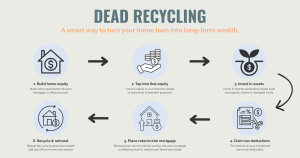
An example of debt recycling in action
Say you have an $800,000 mortgage with an interest rate of 6%. As well as making your normal repayments, you make additional repayments into an offset account. This not only reduces the amount of interest charged but increases your home equity, unlocking a portion of funds available for investing.
Once the account reaches $200,000, you may choose to invest these funds into income-generating investments, such as:
- Shares
- Managed funds
- Investment properties
- Exchange Traded Fund (ETF)
With the average returns on shares around 8%, this could give you an estimated share return of $16,000. The interest on that $200,000 (approximately $12,000) is now also tax deductible as it’s associated with investment debt.
These funds can then be reinvested back into your offset account, used to pay down your home loan debt, or re-borrowed into another investment.
Is debt recycling only a personal investment strategy or can you use it to grow business wealth as well?
While it is often used as a personal investment strategy, debt recycling can also be used to support business growth. For example, if you are a builder or tradie operating as a sole trader, you can use this debt recycling strategy to:
- Unlock additional funds for cashflow and business expenses (such as BAS or debts)
- Create business investment funds for company assets or equipment
Interest on the investment portion is also tax deductible.
For companies or trusts, it’s a little more complex. Instead of redrawing like you would as a sole trader, funds are provided as a commercial loan from you to your business.
To ensure you don’t get yourself in sticky tax trouble, we recommend chatting with an accountant or business advisor such as Mead Partners to ensure you have the right business structure and terms in place beforehand.
What are the benefits of debt recycling?
There are multiple benefits of debt recycling, including:
Unlocking tax-deductible debt
While your home loan is non-deductible, the investment portion of your loan is tax deductible. Turning that bad debt (your mortgage) into good debt (investment debt).
Paying off your mortgage sooner
Investment income and tax savings can be reinvested as extra repayments.
Reducing total mortgage interest
Redirecting your investment income and tax savings into repayments reduces your total mortgage interest paid over the long term.
Building an investment portfolio faster
Instead of saving money or using a personal loan to invest, you use your home equity. Income generated and tax savings can also be reinvested to unlock more investment funds over time.
Diversifying your investments
Instead of only having your primary property, you can invest in non-property investments such as shares and managed funds.
Creating business cash flow
Depending on your company structure, you can use debt recycling to unlock much-needed business funds or buy business assets.
What are the key risks and considerations?
As with any investment strategy, there are risks and considerations that should be assessed before you make a decision.
Key risks can include:
- Market volatility
- Interest rate changes
- Repayment increases
- Asset depreciation (for any company assets bought with borrowed funds)
Debt recycling is also a long-term strategy and takes a lot more dedication, meaning it only works if you keep on top of repayments, investing income and tax savings. It’s also most suited to those with excess cash and for those that are comfortable with additional risk.
Life changes are another consideration. While additional repayments can be adjusted as needed, they need to be made regularly to maximise the most benefits. The additional funds you accumulate can also be used to redraw for emergency purposes.
What you need to get started
Due to the nature of the strategy, it takes a good team behind you to get it right. Not only does it often require a good mortgage broker (as not all banks can support this form of debt management), but a good financial planner to help you uncover the right investment options for you.
For any business related investments, we recommend you speak to your accountant as well as your business advisor. This ensures that not only is your business structured correctly, but you understand what cash flow you need to maintain to keep up with repayments. Your business advisor or accountant and also ensure income and tax savings are reinvested, maximising your benefits.
Could debt recycling benefit your business?
Chat to our team to start the process and step through how debt recycling could work for you. As business advisors, we can provide advice on your business structure, the process, recommendation repayments, as well as investment opportunities to support your business goals.
Send To Someone